
Free planning guide

The first-timer's guide to hotel barge cruising

How to choose a region, what a week actually costs, and the questions to ask before you book. Everything here applies to any barge company, including ours.

Welcome aboard. This guide answers the questions we hear most from first-time barge travelers. Read it, share it with the people you would travel with, and keep the checklist near the end handy no matter who you book with. If you get stuck anywhere, call me. I answer the phone.

Kim Dickey

Owner, French Canal Boat Company · Featured by Rick Steves’ Europe on PBS

What a hotel barge is, and what it is not

Most Americans hear “cruise” and picture a Viking river ship. A hotel barge is a different animal.

A hotel barge is a converted working canal boat with a handful of guest cabins, a private crew, and its own chef. Most carry 4 to 12 guests. The crew typically includes a captain, a chef, a tour guide who drives the excursion minibus, and a hostess. That works out to roughly one crew member for every two guests, which is why the service feels closer to a private home than a hotel.

The other difference is where these boats go. Around 95 percent of barge cruises run on canals dug in the 18th century, waterways too narrow and too shallow for any river ship to enter. You cruise past vineyards and villages at 4 miles per hour, slow enough to step off and walk the towpath beside the boat.
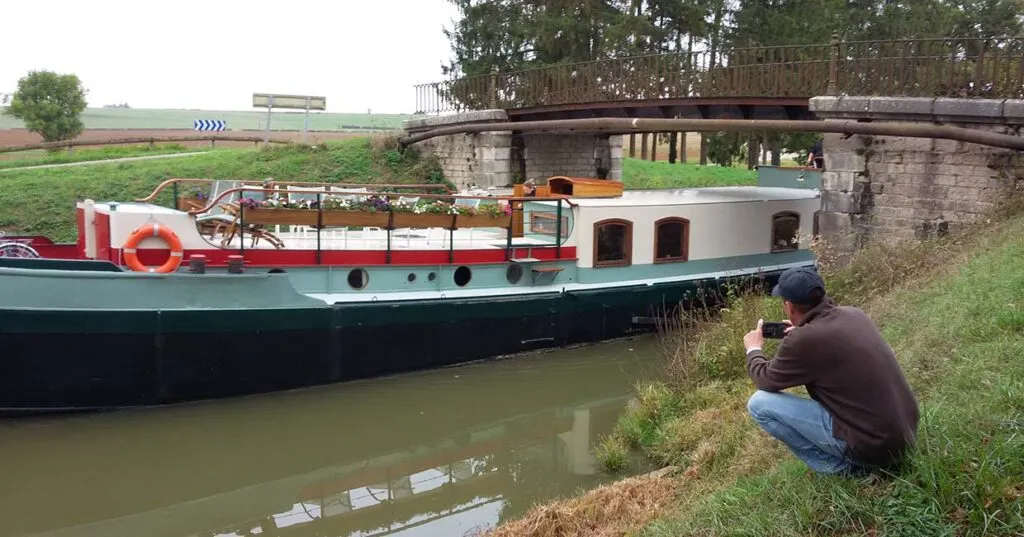
Papillon cruising the canal
This is the whole boat: our barge Papillon, a converted working canal boat carrying four guests and a crew of four.

Hotel barge

River cruise ship

Guests
4 to 12
160 to 190
Waterways
Small canals through wine country and villages
Major rivers between cities
Pace
4 mph, moored every night, about 50 miles in a week
10 to 15 mph, often sailing overnight to keep a schedule
Included
All meals, wine, open bar, excursions with entry fees, bikes, transfers
Base fare, with drink packages and premium excursions sold separately
Feels like
A floating country house with your own crew
A small floating hotel

"Barging is a decadent mix of travel, eating, and relaxing."

Rick Steves’ Europe · PBS · Filmed aboard our barge Papillon
What you actually do all week

Every hotel barge, ours or anyone’s, runs on the same gentle rhythm: cruise half the day, explore the other half, moor in time for dinner.
Morning
Breakfast on board: pastries from the village boulangerie, fruit, good coffee. The barge slips its lines and cruises while you read on deck or ride a bike along the towpath.
Midday
Lunch is a long one. Salads, quiche, regional cheeses, and wines your chef picked to match.
Afternoon
Your guide drives you out in the minibus: a wine tasting, a market, a chateau, a village. Entry fees are already covered.
Evening
Cocktail hour with canapes as the light goes gold, then a chef-prepared dinner with wine pairings. The barge is moored. Nobody sails anywhere at night.
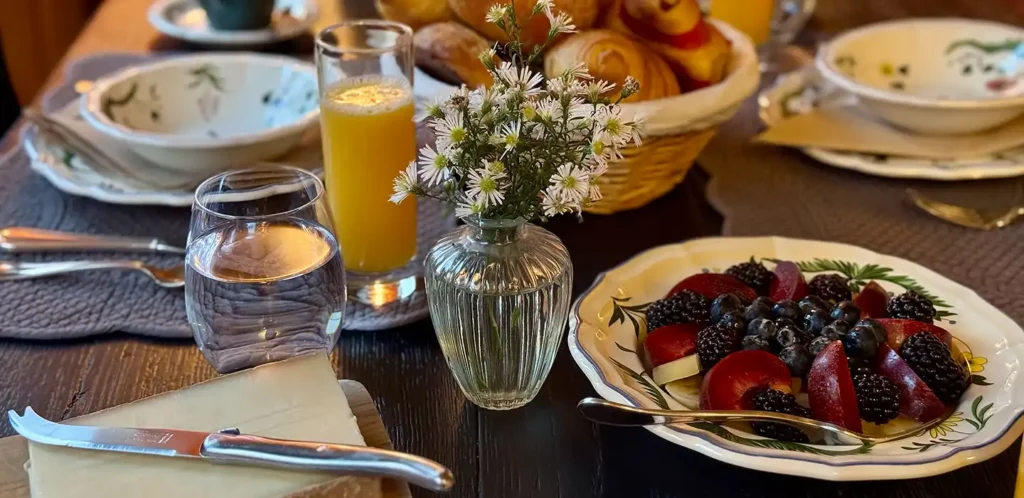
Breakfast with fresh croissants on board
Morning, done properly: pastries from the village boulangerie, laid out before the barge slips its lines.

Locks arrive about every mile on the prettiest canals, and each one is a small show of its own. Because the boat moves at walking pace, you can hop off at one lock, walk or cycle ahead through the vines, and step back aboard at the next. If it rains, the program shifts indoors: the salon is heated, the bar is open, and excursions run by minibus either way.

How to choose your region

Here is the honest shortcut: most of our guests choose by wine, then confirm by weather. Pick the region first, then the boat. Boats vary more than regions do, and that is where we can help.

Burgundy

Quiet canals, stone villages, and Chablis within reach. The classic first-timer choice, and the region where our own Papillon cruises.
Best for: a gentle, storybook first trip

Southern Burgundy

Grand cru country around Beaune, with big-name tastings and serious food. This is the stretch where Rick Steves’ Europe filmed its barge episode.
Best for: wine lovers with a list

Champagne

Cellar visits around Reims and Epernay, with the region’s namesake poured generously. A natural pick for anniversaries and milestone birthdays.
Best for: celebrations

Canal du Midi

The sunny south: a UNESCO-listed canal shaded by plane trees, with Carcassonne’s medieval citadel nearby. The warmest region, so favor spring or September.
Best for: history and southern warmth

Upper Loire

Chateau country, with Sancerre on the pour. Fewer crowds than the famous stretches of the Loire Valley, same postcard scenery.
Best for: castles and quiet

Bordeaux & Brittany

Bordeaux brings vineyard estates with famous names. Brittany trades vines for coastal character and seafood, and stays cooler in summer.
Best for: second trips and contrarians
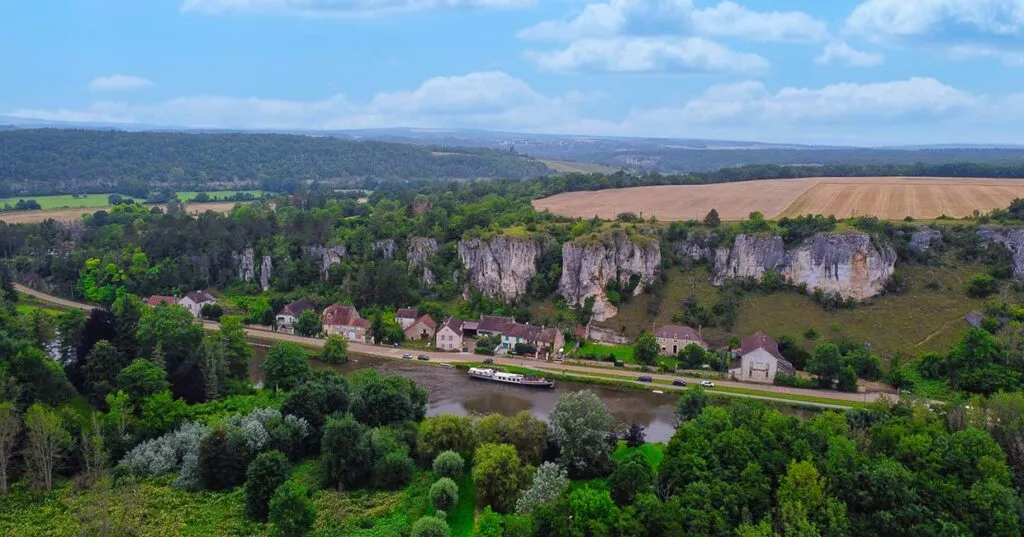
Northern Burgundy from the air
Northern Burgundy from the air: the Nivernais Canal threading the Yonne valley, with the barge the only traffic in sight.

Beyond France: our network also cruises England, Scotland, Ireland, Holland, Belgium, and Germany. Holland is a spring specialty, timed to the April tulip bloom. If you are torn between two regions, this is a five-minute phone conversation. Kim has matched travelers to these canals for years and will tell you plainly which fits.
When to go

The season runs April through October. The reason is simple: France drains and repairs its canals every winter, so the boats cannot cruise. Within the season, here is how the months break.

April

Spring opens the season. Tulip time in Holland, blossom in France, cool evenings.

May · first-timer pick

Countryside in bloom, comfortable days, before the summer crowds.

June

Long, warm days. A favorite for charters, so it books up early.

July

High summer. Lovely in Burgundy and the north; genuinely hot on the Canal du Midi.

August

France on holiday. Warm, lively, and busier on the southern canals.

September · first-timer pick

Harvest begins, temperatures ease, and the light turns golden. Reliably drier in Burgundy.

October

Misty mornings, autumn color, and the last departures of the year.

November to March

Canals closed for winter maintenance. Plan next season instead.
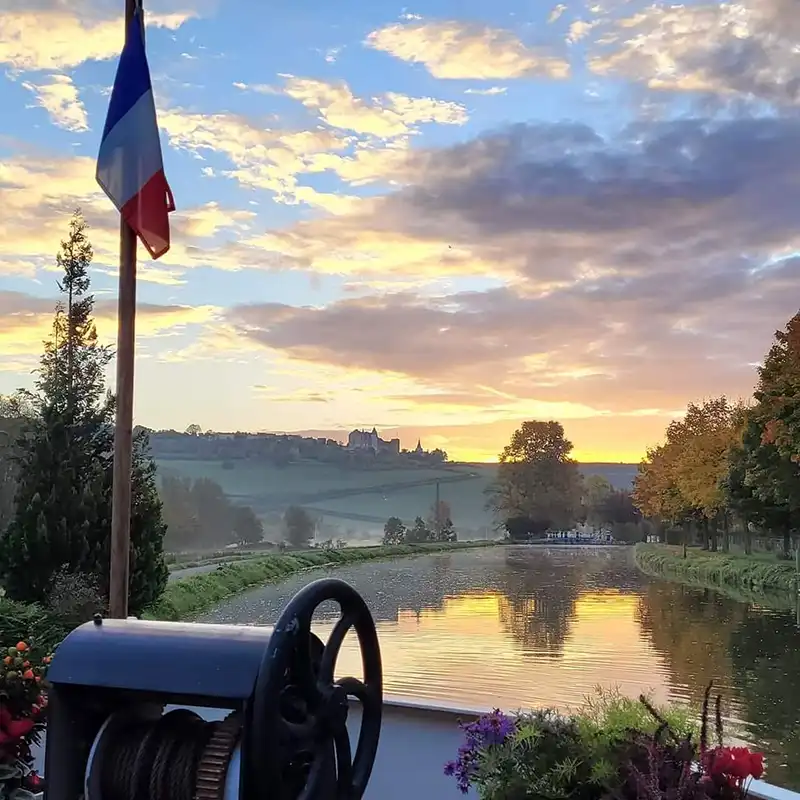
Chateauneuf-en-Auxois seen from the bow of the Savoir Vivre
The September case, made from the bow: golden light, quiet water, and harvest underway in the vineyards.

Book earlier than feels reasonable. The best barges hold 6 guests, not 600, so a single family charter removes an entire week from the calendar. Most of our guests book 9 to 12 months ahead, and June and September fill first. If your dates are fixed, that is the strongest reason to start early.
What a week actually costs

Barge pricing looks high until you see what the number covers. Here are real figures, not teaser rates.

Charter the whole barge

$20,000 to $100,000

Per week, for the entire boat and crew. The math improves fast when you share it: a $36,000 charter split by four couples is $9,000 per couple, with meals, wine, and excursions already in.

Book by the cabin

$5,000 to $12,000

Per person, per week, on a shared departure with set dates. The same boat, chef, and excursions as a charter.
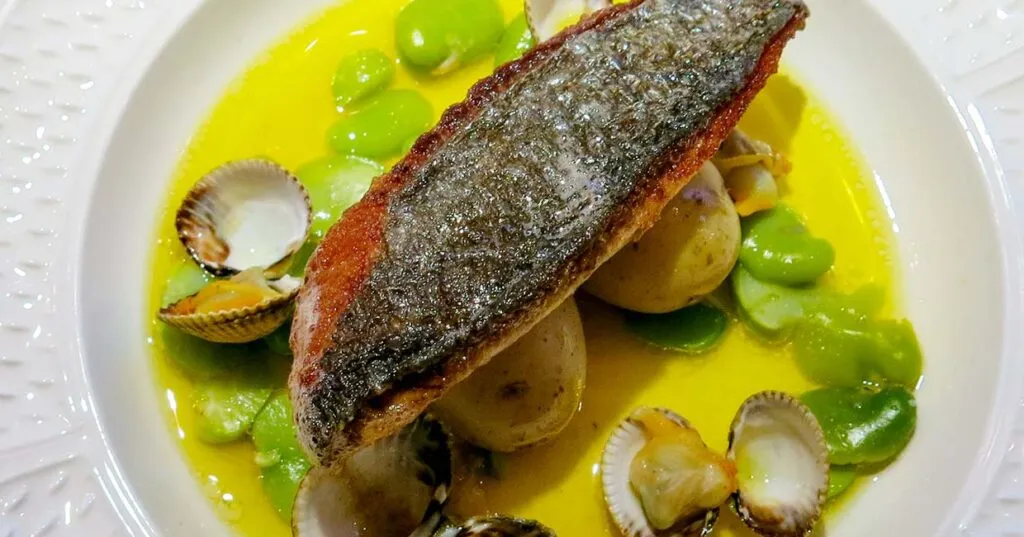
A plated dish from the galley
Part of what the number covers: a private chef cooking every meal of the week, plated like this.

Included in the fare

Budget separately for

Payment and the insurance clock. Booking terms in this industry are standard: a 25 percent deposit holds your dates and the balance is due 90 days before departure. Payments are not refundable, which is normal for boats this small; one cancellation empties the whole vessel. That makes trip insurance part of the real cost, not an extra. One detail that catches people out: “cancel for any reason” coverage usually must be purchased within about two to three weeks of your first deposit. Buy your policy the same week you book.

Charter the boat, or book a cabin?

Same barge, same chef, same canals. The difference is who else is aboard.
For families, friend groups, milestones

Private charter

You take the whole boat, 2 to 12 guests. You choose the dates, tune the menu, and swap excursions to suit your group. The only people aboard are your people and the crew.

About 8 in 10 of our bookings are charters, usually organized by one person who then gets the fun of telling everyone else.
For couples and solo travelers

By the cabin

Join a set departure and share the barge with a few other travelers. It is the affordable way in, and the table conversation is part of the charm.
One honest tip: if you are a couple traveling alone, choose a barge that sleeps 8 or more. On a 4-guest boat, you are effectively on holiday with one other couple you have never met.
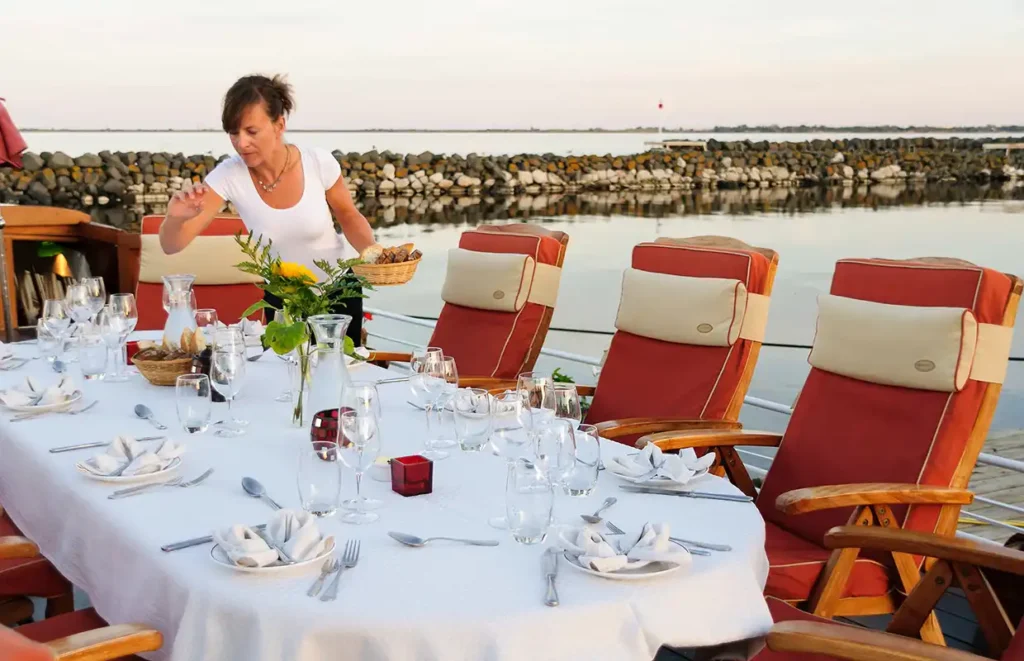
Dining on the deck of the Athos
Either way, this is the table. On a charter it holds your people; on a cabin booking, a few fellow travelers join it.

The 10 questions to ask before you book

Ask these of any barge company, including us. A specialist who knows their boats will answer all ten from memory. If you get vague answers, keep shopping.

1

Where does the barge moor each night?

Some moorings are village centers where you step off into a market square. Others are working docks outside town. The itinerary rarely says which, so ask.

2

Who exactly is the crew?

The standard worth insisting on is one crew member for every two guests, English speaking. On the smallest boats two people wear several hats. Know before you go.

3

What are the beds, really?

Cabins vary hugely from boat to boat: fixed doubles, twins that convert, singles. If you need a true double or two proper twins, confirm the exact cabin.

4

Is the barge fully air conditioned and heated?

Most quality barges are, but confirm it for any individually owned boat, especially for July or August in the south of France.

5

How steep are the stairs?

Barges are converted working boats. Stairs can be steep and there is no elevator. Ask for cabin and deck step counts, and disclose any medical conditions honestly. Operators can refuse boarding over undisclosed ones.

6

Which excursions are included, and can we swap them?

Entry fees should be covered, full stop. On a charter, a good operator will trade the standard chateau visit for golf, canoeing, or a market morning if that suits your group better.

7

What are the payment schedule and cancellation terms?

Non-refundable payments are standard across the whole industry. What matters is that terms are put in writing before your deposit, and that insurance is discussed at the same time.

8

Where is the meeting point, and are transfers included?

Cabin bookings collect guests at a set city meeting point. Charters can usually arrange one custom pickup. Confirm both the place and the time before you book flights.

9

If we book cabins, who else will be aboard?

Ask how many other guests are confirmed and what the boat’s typical guest profile is. Six strangers at one table all week is wonderful or wearing, depending on the six.

10

Can the chef handle our dietary needs?

A private chef cooking for eight can accommodate nearly anything that is flagged at booking. The key phrase is at booking, not at the dock.

Why people end up calling Kim with this list. We represent 35 barges across Europe, and Kim has owned and run her own boats on these canals, so she answers these questions boat by boat: which barges moor in village centers, which cabins have true fixed doubles, which decks stay shaded in July. That is the whole point of working with a specialist instead of booking blind from a brochure.

Straight talk: what barging is not

We would rather tell you now than have you discover it aboard. Barging is a poor fit for some travelers, and pretending otherwise helps nobody.
Barges are not wheelchair accessible. Stairs are real and often steep. If anyone in your party has serious mobility limits, tell your booking agent before paying a deposit. This is the one area where honesty in both directions matters most.
Cabins are snug. Think well-appointed ship’s cabin, roughly 100 to 250 square feet depending on the boat’s class, with an en-suite shower. You will spend your waking hours on deck, in the salon, or out in France.
Wi-Fi exists but can be thin. Rural French canals are not built for video calls. Most guests decide by day two that this is a feature.
You will need some cash. The crew tip at week’s end is cash by convention, and village markets prefer it. Nearly everything else is prepaid.
Seasickness, though, is not on the list. Canals are still water with a 4 mph speed limit, and the boat is tied up every night. If motion worries you, this is the calmest floating vacation that exists.

Packing, in one paragraph

There are no formal nights on a barge, so leave the gown and the good jewelry at home. Pack layers for mornings that start crisp and afternoons that turn warm, comfortable walking shoes for villages and towpaths, soft-soled shoes for the deck, a swimsuit if your barge has a spa pool, sun protection for open-deck cruising, and one slightly smarter outfit for the captain’s farewell dinner. A soft duffel stores better than a hard shell in a snug cabin. That is genuinely the whole list.

"A gourmet barge vacation in Burgundy? C'est magnifique!"

Rick Steves’ Europe · PBS

Ready to look at real dates?

Browse every barge and departure in one place, or skip ahead and talk it through. Kim will tell you within one call whether a barge week fits your group, and which boat she would put you on.

Free planning guide

The first-timer’s guide to hotel barge cruising

How to choose a region, what a week actually costs, and the questions to ask before you book. Tell us where to send it.

Get the full itinerary

Every day, every detail: what to pack, what to expect at each stop, and Kim’s insider tips for getting the most from this departure.

Check availability for Planning Guide

Cabin booking · join a set departure
The WeTravel booking and deposit checkout embeds here at launch. Guests will choose their week and place the deposit without leaving the page.

Until it is live, call Kim at  888-229-2315, or request the full itinerary to start the conversation.

Check availability for Planning Guide

Private charter · the whole barge

The WeTravel booking and deposit checkout embeds here at launch. Guests will choose their week and place the deposit without leaving the page.

Until it is live, call Kim at  888-229-2315, or request the full itinerary to start the conversation.